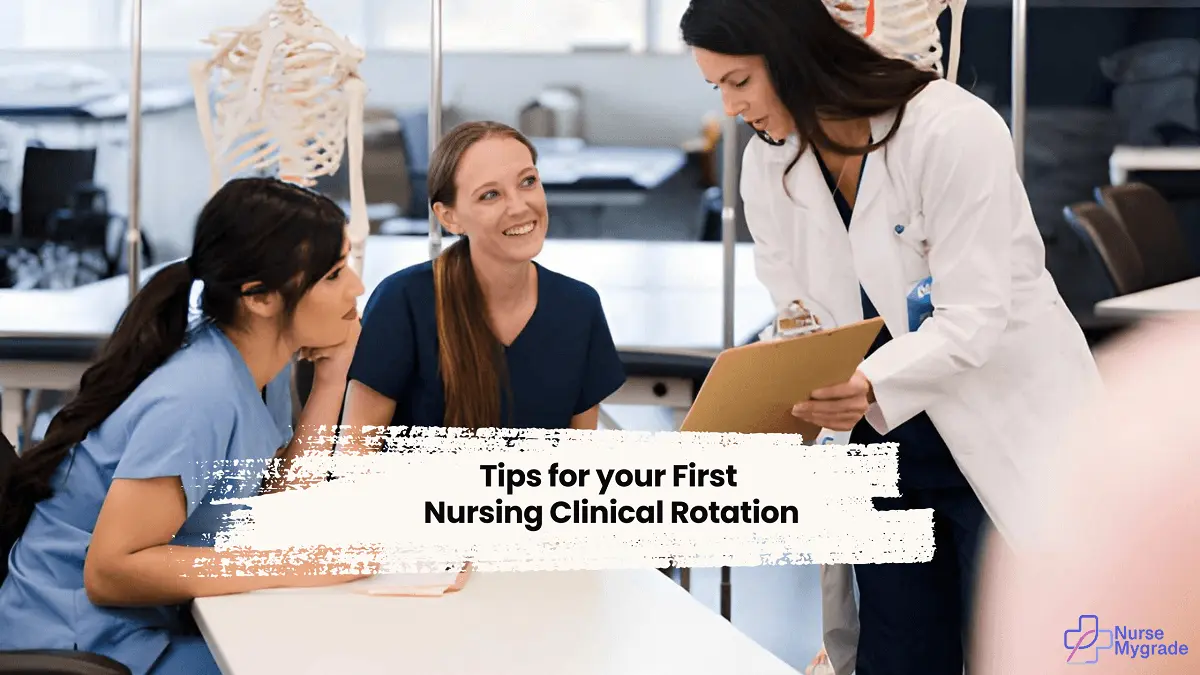
There is a particular kind of anxiety that arrives the night before your first clinical rotation. You have studied pharmacology until the drug names blur. You have practiced your head-to-toe assessment on your roommate so many times they can now recite the steps back to you. You have ironed your scrubs, packed your stethoscope, and read everything you could find about the unit you are being placed on. Yet, standing at the threshold of an actual hospital ward, with actual patients who have actual conditions that do not behave like textbook cases, none of that preparation feels like quite enough.
This is entirely normal, and it is temporary.
Clinical rotations are the most significant phase of your nursing education. They are where the knowledge you have accumulated stops being abstract and starts being real. They are also, if we are being honest, more demanding, more emotionally complex, and more humbling than most nursing students expect, and at the same time, more rewarding than any classroom experience can approximate.
We wish nursing students had this guide before their first shift. Not the sanitized version that tells you to "be professional and ask questions," but the thorough, honest, practical account of what clinical rotations are really like. We go deeper including what is expected of you as a nursing student on rotation, what will surprise you, what will challenge you, and how to get the most out of every hour you spend on the floor.
Clinical rotations are the supervised, hands-on component of your nursing program where you work directly with patients in real healthcare settings. Unlike simulation labs such as iHuman or Shadowhealth, where you practice on mannequins in controlled conditions, clinical rotations place you in live environments such as hospitals, clinics, community health centers, psychiatric facilities, maternity wards, pediatric units, and nursing homes, where decisions have consequences and the pace does not slow down for your learning curve.
Most BSN programs require between 700 and 1,000 clinical hours distributed across different specialties over the course of the program. You will typically spend four to eight weeks in each specialty area, working shifts of 8 to 12 hours. Some programs structure rotations early in the curriculum so students gain clinical exposure before completing advanced coursework; others delay clinical placement until foundational theory is firmly established. Either way, by the time you graduate, you will have moved through several distinct clinical environments, each with its own culture, patient population, skill set, and demands.
You will not be alone. Clinical rotations are supervised, either by a clinical instructor assigned to a small group of students, by a preceptor (an experienced registered nurse on the unit who takes responsibility for your learning), or by a combination of both. The supervision structure varies by program and placement, but the expectation is consistent across all settings: you are a learner, and your primary responsibility is to grow as a clinician while maintaining patient safety at all times.
Understanding what an ordinary clinical shift looks like helps reduce the anxiety of not knowing what to expect. While every unit and every program has its own rhythms, the broad structure is consistent.
Before the shift begins, your clinical instructor or preceptor will hold a brief pre-conference session with the student group. This is where patient assignments are discussed, learning objectives for the day are set, and any specific skills or procedures you will be attempting are identified. Pre-conference is also the moment to raise any concerns or questions you have before stepping onto the ward. Come prepared: know the basics about any patients you have been assigned in advance.
You will typically be assigned one to two patients at the beginning of your rotation experience, increasing to three or more as your confidence grows. You will receive a handover from the outgoing nurse. A handover is a structured summary of the patient's condition, current medications, pending investigations, and care priorities. Listening carefully during handover is a skill in itself. You should be attentive because the ability to absorb and organize clinical information quickly is one of the most important things you will develop during rotations.
One of your core responsibilities in most rotations is completing a nursing assessment of your assigned patient: vital signs, physical assessment, mental status, pain level, skin integrity, fluid balance, and anything specific to the patient's condition or admission diagnosis. You will document your findings and report any changes or concerns to your preceptor or instructor.
Depending on your level and your program’s scope of practice guidelines, you will assist with or independently perform a range of nursing interventions. Some of those include medication administration, wound dressing changes, catheter care, IV monitoring, patient positioning, patient education, discharge planning, and more. What you are permitted to do independently versus what requires direct supervision will be made clear during orientation and will expand as your competency is demonstrated.
In most clinical settings today, documentation is electronic. You will learn to navigate whatever electronic health record system the facility uses. Note that different placements may use different systems. Accurate, timely, and professional documentation is a legal and ethical requirement, not an administrative chore. You should put all your efforts in it because your instructors will treat it with corresponding seriousness.
At the end of the shift, your clinical group reconvenes for a post-conference discussion. This is where students share what they experienced during the shift, reflect on challenges, discuss clinical reasoning, ask questions that arose during care, and consolidate learning. Post-conference is one of the most valuable parts of the clinical day. The habit of reflection, entailing sitting with what you saw, what you did, and what you would do differently, is foundational to developing clinical judgment over time.
Clinical programs vary in their sequence and structure, but most nursing students rotate through the following major specialty areas before graduation. Each offers a distinct learning experience and attracts different kinds of nurses.
Med-surg is almost universally the first major clinical rotation and the one that forms the bedrock of general nursing practice. You will care for adult patients with a wide range of acute and chronic conditions — post-operative patients recovering from surgery, patients with cardiac, respiratory, gastrointestinal, neurological, or endocrine conditions, and patients managing multiple comorbidities simultaneously.
What to expect: a busy, high-volume environment that tests your organizational skills from day one. Med-surg nurses typically manage four to six patients per shift, and as a student, you will begin with one or two before gradually taking on more. You will perform medication administration, wound care, vital sign monitoring, patient education, and handover documentation. You will see how nursing care plans translate into actual daily care decisions.
What med-surg teaches you: prioritization, time management, the ability to manage multiple patients with different needs simultaneously, and the foundational clinical skills that every other specialty builds on. Many experienced nurses describe med-surg as the best preparation for any direction in nursing precisely because it is relentless, varied, and unrelenting in its demands.
The obstetrics rotation places you in the care of pregnant women, laboring mothers, postpartum patients, and newborns. It is one of the few clinical rotations where your patients are predominantly healthy. Mainly, pregnancy is a physiological process, not an illness. However, things can deteriorate very rapidly and where the emotional stakes are exceptionally high.
What to expect: the rhythm of OB is different from any other unit. You may spend long stretches of a shift monitoring a patient who is progressing steadily through early labor, and then suddenly find yourself in the middle of a fast-moving emergency. You will learn fetal heart rate monitoring, labor assessment, postpartum care, newborn assessment (APGAR scoring, weight, temperature, newborn medications), and breastfeeding support. You will also witness birth, which is an experience that no amount of reading can fully prepare you for.
What OB teaches you: family-centered care, patient advocacy, close monitoring of physiological parameters, and the ability to hold steady in emotionally charged situations. Many students are surprised by how technically demanding OB is alongside its emotional dimensions.
Pediatric nursing covers patients from newborns through adolescents, and the learning curve is steeper than many students anticipate. Children are not small adults — their physiology, their pharmacological responses, their developmental stages, and their communication needs are all fundamentally different, and their families are an inseparable part of their care.
What to expect: weight-based medication calculations are mandatory and must be precise. Communication with pediatric patients requires adapting your language, your approach, and your demeanor to the developmental stage of the child you are caring for. Parents and caregivers are present, often anxious, and need to be included in every aspect of care planning and education. You will also encounter the emotional weight of ill children, which many students find more challenging than any other aspect of the rotation.
What pediatrics teaches you: family-centered care in its most demanding form, developmental assessment, age-specific communication, and precision in medication management. You will also practice and perfect the ability to read clinical signs in patients who cannot reliably self-report their symptoms.
The psychiatric rotation is often the one students approach with the most uncertainty. As you will notice, it will leave you having learned more about yourself than you might have expected. You will be placed in inpatient or community mental health settings caring for patients with acute and chronic mental health conditions: schizophrenia, bipolar disorder, major depression, anxiety disorders, personality disorders, substance use disorders, and more.
What to expect: the physical skills of nursing take a back seat here. You will not be placing IV lines or changing dressings. Your primary clinical tool is therapeutic communication. Here you have to put to practice the ability to build rapport, establish trust, conduct a mental status examination, recognize warning signs, and engage patients in ways that support their recovery and safety. You will attend group therapy sessions, participate in multidisciplinary team meetings, and learn to sit with patients whose experiences may be profoundly unfamiliar.
Like many students, you will be surprised by how much psychiatric nursing challenges your assumptions about mental illness, human behavior, and what nursing care looks like when it does not involve clinical procedures. Risk assessment, particularly around suicidal ideation and self-harm, will be covered in orientation and with your preceptor; do not attempt to manage these independently.
What psych teaches you: therapeutic communication, active listening, de-escalation techniques, mental status assessment, empathy without over identification, and the limits of fixing — that sometimes the most powerful nursing intervention is sustained, non-judgmental presence.
Not all programs include a dedicated critical care rotation at BSN level. However, where it is offered, it is consistently reported as one of the most intense and formative experiences of nursing school. The intensive care unit cares for patients with life-threatening conditions who require continuous monitoring and highly complex interventions: mechanical ventilation, hemodynamic monitoring, vasopressor infusions, post-operative cardiac surgery care, and multi-organ failure management.
What to expect: the patient-to-nurse ratio is much lower than med-surg. Typically 1:1 or 1:2. However, the complexity per patient is dramatically higher. The volume of technology is significant: ventilators, arterial lines, central venous catheters, infusion pumps running multiple drips, continuous cardiac monitoring. Your role as a student will be largely observational and assistive in the early stages, gradually taking on more direct care under close supervision.
What ICU teaches you: hemodynamic principles advanced clinical observation, the ability to process and respond to enormous volumes of patient data, and a deep respect for the narrowness of the margin between stability and crisis.
Community health rotations take you out of the hospital and into clinics, schools, community centers, and patients' homes. The focus shifts from acute care to prevention, health promotion, and the management of chronic conditions in populations. You may work in a school nursing role; conduct home visits, support immunization programs, or work alongside community health workers in underserved areas.
What to expect a very different pace and a very different model of nursing practice. Community health nursing requires you to think at the population level, not just the individual level. You will conduct health needs assessments, provide patient education, and engage with the social determinants of health, poverty, housing insecurity, food access, in ways that hospital settings rarely confront directly.
What community health teaches you: health promotion, disease prevention, cultural competence, resource navigation, and a broad systemic understanding of the factors that determine health outcomes.
The practical structure of clinical rotations is knowable in advance. What is harder to prepare for are the experiential realities, which is the things that catch most students off guard.
Your preceptor is, in many ways, the most important person in your clinical learning experience. They are an experienced registered nurse who has agreed to take on the additional responsibility of supervising and teaching a student while continuing to deliver patient care. Their time is limited, their workload is real, and they do not have infinite patience. However, key to note is that in the vast majority of cases, they are also genuinely invested in your development.
Here is how to make the most of this relationship:
Preparation is not just reviewing notes the night before. A structured habit should begin when you receive your clinical placement.
Clinical rotations are factories for forming and forging your professional identity. The habits you develop on your first rotation such as your approach to handover, your documentation practices, your communication style with patients and colleagues, and your attitude toward feedback, tend to become durable. Good habits formed early are a significant professional advantage.
Even the rotations that are not in your area of interest offer something essential. The psychiatric rotation teaches you communication skills that will serve you in every clinical setting for the rest of your career. The community health rotation teaches you to think about patients as people embedded in social contexts. The rotation you least want to do often delivers the lesson you most need to learn.
Approach every placement with the same question: what is there to learn here that I cannot learn anywhere else? The answer is always something.
As someone who has guided students through clinical rotations, here is a note on looking after yourself during your clinical rotation.
Clinical rotations are demanding both physically and emotionally in ways that are difficult to anticipate. Twelve-hour shifts on your feet, emotional encounters with suffering, the cognitive load of rapid clinical learning, and the social intensity of team environments are all real stressors. Managing them is not weakness; it is the baseline professional responsibility of anyone working in healthcare.
Sleep, nutrition, and physical activity are not optional. The temptation to study through the night before a shift and recover on weekends is understandable and counterproductive. Remember, impaired cognitive function compromises both your learning and your patient care. Build a sustainable rhythm from the beginning.
Talk about what you experience during rotations. Be open with your clinical group, with your instructor, and with trusted people outside the program. Debrief encounters that were difficult. If you find yourself carrying the emotional weight of a particularly difficult case, a patient who died, a family encounter that affected you, and a situation that felt beyond your coping, name it and seek support. The ability to process emotional experience rather than suppress it is the foundation of a sustainable nursing career.
Clinical experience does not exist in isolation from your academic work. The patients you care for should inform the nursing research papers you write, the care plans you develop, and the essays you submit. The connection between clinical observation and evidence-based practice is precisely what nursing education builds upon. Now, the nursing students who make this connection actively, rather than treating classroom and clinical as separate worlds, are the ones who develop fastest.
When you observe a clinical practice, ask: what does the evidence say about this? When you write a research paper, ask: how does this finding translate to actual patient care decisions? The loop between theory and practice is what clinical rotations exist to close.
If you need support with the academic side of your nursing program such as research papers, care plan write-ups, reflective essays, literature reviews, or any other assignment, NurseMyGrade's team of nursing writers understands both sides of that equation. Every writer on our team is a qualified nurse who has been through clinical rotations and understands what nursing academic work demands.
For specific resources:
Clinical rotations will challenge you in ways you do not fully anticipate. They will also show you things about yourself: your resilience, your compassion, your capacity to think under pressure, and your commitment to this profession, that no classroom ever could. Go in prepared, stay curious, remain humble, and trust the process.
The nurse you will become is being formed right now, one shift at a time.


NurseMyGrades is being relied upon by thousands of students worldwide to ace their nursing studies. We offer high quality sample papers that help students in their revision as well as helping them remain abreast of what is expected of them.
Get Help