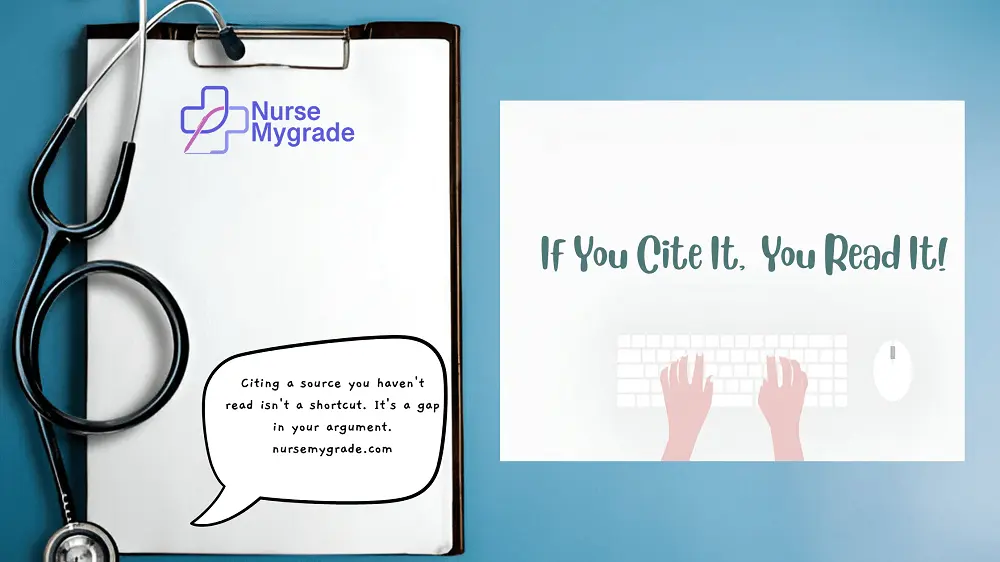
A perennial debate in academic writing has a clear answer, and students need to hear it.
The question surfaces constantly in online academic forums, student communities, social media, and university writing centers: do you actually need to read every source you plan to cite? Someone, usually a student under deadline pressure, occasionally a weary graduate researcher, floats the idea that abstracts are enough, that secondary citations are acceptable, that the sheer volume of academic literature makes comprehensive reading an impossible standard. Others push back hard, insisting that citing a source you have not read is a form of academic dishonesty, more like a quiet lie embedded in your reference list.
What is right cannot hide, and even when it does, it always saves the day when wrong happens. This article takes a clear position: you must read every source you cite, without exception. Not the abstract. Not the conclusion paragraph alone. The source, adequately and with understanding. The argument is not moralistic grandstanding. It is grounded in what research and writing are fundamentally for, and what happens, practically and intellectually, when students skip this step.
If you need help with your nursing school assignments, please place an order and get professional help from real writers (NO AI tools).
When academics and students argue about whether you need to read cited sources, the surface-level debate is about convenience. The deeper issue is about what citation actually means and what it is supposed to do.
The shortcuts tend to cluster around a few familiar positions: "I've read the abstract; it supports my point, citing it is fine." It also borrows heavily from the ideal that: "After all, everyone does it. Secondary citations are standard." Or, more brazenly ", No professor actually checks whether you read the source."
Each of these positions reveals a misunderstanding of the purpose of citation. A citation is not a decoration. It is not a signal to your reader that you have done a certain number of Google Scholar searches. It is a claim, a representation that the cited source says what you say it says, that it supports the argument you are making, and that you understand it well enough to deploy it accurately in your work. You make a claim, and find scholarly sources that support it, not the other way round.
When you cite a source you have not read, you are making a claim you cannot verify. That is not a minor procedural failure. It is an epistemic one. Frankly speaking, in fields like nursing, medicine, and the health sciences, where ideas in research papers directly inform clinical practice, it is potentially a dangerous one.
The concerns are not hypothetical. The Citation Project, a large-scale research initiative examining how first-year college students engage with sources, found that students overwhelmingly engage with sources at the sentence level rather than the idea level. In their analysis, researchers found that none of the 18 undergraduate research papers they examined included a summary of any source. Shockingly, this means that the students were not reading and synthesizing whole articles. Instead, they were lifting individual sentences and paragraphs, often paraphrasing so minimally that it bordered on plagiarism.
Researcher Rebecca Moore Howard argued that this pattern does not necessarily indicate laziness. Rather, it reflects a writing pedagogy that prioritizes efficiency and product over genuine intellectual engagement. Students are taught to find evidence and plug it in, not to read, think, and develop an independent position that is then supported by evidence they genuinely understand.
A separate eye-tracking study from BYU found that both graduate students and professors spend far less time looking at citations than the surrounding text. This suggests that readers largely trust that citations are accurate. The high-level trust is the very thing that citation fraud exploits. The system of academic referencing operates on good faith, and when students cite sources they have not read, they erode that foundation.
One of the most common shortcuts in academic writing is the secondary citation: citing a source based on another author’s description of it rather than reading the original. Style manuals permit this in rare circumstances: when an original source is genuinely inaccessible. However, students frequently use it as the default rather than the exception.
The problem with secondary citations, beyond the obvious integrity issue, is that they propagate misreading. If Author A mischaracterizes Source X, and you cite Source X based on Author A’s description, you are not just citing something you have not read. Instead, you are potentially spreading an inaccurate interpretation. This is how factual errors circulate through academic literature and accumulate citations over time, each new student trusting the previous one’s chain of relay.
A researcher at ResearchGate described reviewing papers and finding “several sentences which citations are wrong. For example, a big paragraph refers to an original paper as the source of info, but when you go there, that info is not from that paper.” This phenomenon, wrong citation, right format, is usually the product of someone citing a source they never actually opened.
Something has been happening. Lately, with everyone vibe coding, summarizing PDFs, and just wanting everything in an instant, the risk of fake in-text citations has soared. It is an academic pandemic. AI does not understand context. Let us dwell more into this because we risk losing the plot.
In our experience, authors who construct a paper around superficial reasoning often by prioritizing flow and coherence over genuine intellectual engagement, consistently undermine its depth. The result is a paper that hits the word count but says very little of substance. Every paragraph moves, but nothing accumulates. The argument does not build; it merely continues. Sentences connect to one another without the ideas behind them actually going anywhere. A reader, and certainly a marker, can feel this hollowness almost immediately, even when they cannot always articulate exactly what is wrong.
The problem is compounded by a particular writing habit that is more common than most students admit: working backwards from sources to argument rather than the other way around. When a student finds a source that sounds relevant, slots it into a paragraph, and writes around it rather than from a position of genuine understanding, the citation becomes load-bearing in the worst possible way. The source is doing the thinking that the student has not done. The writing survives only as long as nobody looks too closely at whether the cited evidence actually supports the claim you made, and often, it does not.
This situation has grown considerably worse with the proliferation of AI writing tools. The problem with AI-assisted writing, including citation, is not merely that it is lazy; it is that it is structurally deceptive in ways that are difficult to detect and easy to mistake for legitimate scholarship. AI tools do not retrieve sources they have read and understood. They generate plausible-sounding citations based on probabilistic pattern-matching. They do well in predicting, from the surrounding text, what kind of source ought to exist and constructing a reference that fits the shape of that expectation. The result is a citation that looks correct in format, sits in the right place in the sentence, and gestures at the right kind of authority. However, it is hollow and useless as it may refer to a source that does not exist, does not say what is claimed, or addresses an entirely different question in an entirely different context.
Even when AI tools propose citations to real, retrievable sources, the selection logic is based on surface-level semantic similarity rather than substantive relevance. The tool identifies keywords and conceptual proximity; it recognizes that a paper about hand hygiene and infection control likely involves certain authors, certain journals, certain recurring phrase, and matches accordingly. What it cannot do is evaluate whether a specific finding from a specific study, produced under specific methodological conditions, actually applies to the argument you are making in this paragraph. That judgment requires reading. It requires understanding the study’s population, its limitations, its context, and the degree of confidence the authors themselves placed in their conclusions. None of that is accessible through pattern prediction. None of it is visible in a title and an abstract scraped from a training corpus.
The deeper consequence is that AI-assisted citation does not just produce inaccurate references. More profoundly, it actively discourages the kind of engagement that academic writing is supposed to develop. When a student or any writing professional or author accepts a machine-generated citation without verifying it, they are not merely taking a shortcut; they are opting out of the intellectual process entirely. They are submitting a paper that has the structure of research without having done any. By doing so, they are training themselves, over time, to treat sources as decorative rather than evidential, which should be the case. Sources, in academic writing, should be a layer that establishes rather than signal credibility.
There is an intellectual case here beyond the ethical one. Reading your sources is not a burden layered on top of writing. Rightfully speaking, it is the actual research process. The ideas you develop in your paper emerge from the engagement you have with the literature, not from scanning abstracts.
Consider what happens when you read a source properly. You encounter the full argument, not just the conclusion. You see the methodology, the limitations the authors themselves acknowledge, and the context in which produced the finding. You notice when a result is tentative rather than definitive. You discover that a study cited everywhere as foundational was actually a small, convenience-sampled trial. You find, sometimes, that the abstract slightly misrepresents the body of the paper, or that the conclusion says something far more qualified than what other people have been attributing to it.
None of this is accessible from the abstract alone. In addition, all of it is relevant to whether and how you use the source in your own argument.
Yale University's Writing Center puts the matter well: working with sources should inspire your own ideas and enrich them, and the citation of those sources is the visible trace of that intellectual debt. This is an important formulation. The citation is the trace of genuine engagement. It records what has already happened when a student has truly done the reading. When the reading has not happened, the citation becomes a forgery of that trace.
Most academic institutions explicitly address citation integrity in their plagiarism policies, even if they do not always frame it in these terms. Webster University, for instance, specifies that a student’s inability to explain key concepts or sources in a paper constitutes compelling evidence of academic dishonesty.
This is worth sitting with. If you cite a source and cannot explain what it argues, simply because you did not read it, you may be liable for a form of plagiarism even if you formatted the reference correctly. The integrity issue in citation is not only about copying text without attribution; it is equally about claiming intellectual grounding you do not actually have.
For nursing students especially, this carries real stakes. A nursing research paper that cites clinical evidence inaccurately, because the student cited a source based on another paper’s paraphrase, could reflect conclusions that the original research does not support. In an academic context, that earns a poor grade. In clinical practice, where nurses rely on evidence-based research to make care decisions, that kind of citation contamination is more serious.
If you are working on a nursing research paper and feel overwhelmed by the reading requirements, our comprehensive guide on how to write a nursing research paper walks you through every stage of the process, including how to research effectively and cite sources with integrity. It is a useful anchor for students who want to develop genuine skills rather than workarounds.
The most coherent version of the "you don't need to read everything" argument is the pragmatic one: academic literature is vast, time is limited, and requiring full reading of every cited source creates an impossible standard. This objection deserves a serious answer.
First, the volume objection conflates two different things: the breadth of reading you do during the research phase and the sources you ultimately cite. You will read far more during your literature search than you will end up citing. Realistically, this is healthy for you as the entire process helps you to develop your arguments and find means to strengthen your claims. The sources you cite should be the ones most directly relevant to your argument, and they should be manageable in number precisely because you have filtered from a broader pool. If you cannot read twenty cited sources, the problem may be that you are citing too broadly, not that reading is optional.
Second, the time argument often reflects poor planning rather than genuine impossibility. Students who leave research to the last few days find themselves scanning abstracts because they have no time left. Notably, the students who begin research early, often using tools like databases, structured searches, and systematic reading strategies, find that reading sources is the core of their process, not an afterthought to it.
Third, the pragmatic objection proves too much. By the same logic, a nurse could justify administering a drug without reading the contraindications because time is short and there are many patients. The fact that shortcuts feel necessary does not make them appropriate. In both cases, the stakes of getting it wrong are the reason the full engagement is required, not a reason to skip it.
Dr. Nick Braune of Brunel University conducted a fascinating experiment in this area, implementing what he called a “Reference Appendix” requirement: students in his environmental science courses could cite only sources they had read and reflected upon, and they had to submit written evidence of that engagement with every assessment. The results were striking: writing quality improved, plagiarism attempts dropped, and students' ability to discuss their own papers in depth increased substantially.
The idea that you must earn the right to cite a source is pedagogically powerful. It frames citation not as an administrative requirement but as an intellectual achievement, hugely decoded as the record of genuine understanding. When students think of their reference list as something to be earned, they approach research differently. They read to understand, not to collect.
Nursing as a discipline is grounded in evidence-based practice. The entire framework of modern nursing, the PICO model for clinical questions, the hierarchy of evidence from systematic reviews down to expert opinion, the emphasis on peer-reviewed sources from databases like CINAHL, PubMed, and the Cochrane Library, is built on the assumption that the practitioner can evaluate evidence, not merely locate and cite it.
When nursing students develop the habit of citing without reading, they are not just failing their assignments. They are failing to build the critical appraisal skills that evidence-based practice requires. They are training themselves to treat published research as a box to tick rather than an argument to engage. Moreover, they are entering a profession in which those skills matter for real patients. Research and continuous learning is a mainstay in nursing practice, even AI will not change that any time soon.
Our complete guide to writing a nursing essay makes this point clearly: research widely, use peer-reviewed scholarly sources, and support your arguments with evidence you understand. The guide emphasizes that the goal of a nursing essay is to demonstrate theoretical understanding. Yes, this is something you cannot fake convincingly if you have not actually read what you are citing.
One of the best ways to build genuine reading habits is through the annotated bibliography. A structured assignment that requires students not just to list sources but also to summarize, evaluate, and contextualize each one. An annotated bibliography forces the reading to happen by making it visible.
For nursing students unfamiliar with the format, the annotated bibliography is a rigorous exercise in critical appraisal. It requires engagement with the methodology of each study, the quality of the evidence, and the relevance to your specific topic. Done well, it produces exactly the kind of deep familiarity with sources that genuine citation requires.
If you are working on an annotated bibliography for a nursing course, you most probably need a detailed guide. Do you want guidance on the best topics or format? Then, our guide to nursing annotated bibliography topics is a practical resource. It covers how to select strong, researchable topics and how to engage with sources substantively, which is, ultimately, the skill that all citation practice should be building.
Reading your sources is the starting point, not the endpoint, of good citation practice. Here is what the full process looks like for a student who takes it seriously.
If you are struggling with plagiarism avoidance as part of this process, our in-depth guide on how to avoid plagiarism in a nursing research paper is worth reading carefully. It covers paraphrasing, citation, and the intellectual habits that separate genuine research writing from academic dishonesty.
Behind all of these practical considerations is a question of purpose. Why does academic writing require citations at all?
The answer is that academic knowledge is built cumulatively and collectively. When you cite a source, you are locating your work within a conversation that has been happening for years, sometimes decades. You are saying: here is what has been established, here is where it is contested, and here is where my contribution enters. That positioning only makes sense if you actually understand the conversation you are entering.
Students who cite without reading are not entering that conversation. They are performing the appearance of it. Their papers have all the visual markers of research, the in-text citations, the references page, the scholarly vocabulary, without the substance that those markers are supposed to represent. That is more like a human without a soul. One that exists just for the sake of it.
This is, in the end, what is really at stake in the X/Twitter debate about reading sources. The question is not whether it is technically possible to format a citation without opening the source. Of course it is. The question is whether academic writing, and academic education, is about developing genuine capacity: the ability to read, understand, synthesize, and argue, or about producing artefacts that look like that capacity without actually embodying it.
The answer should be obvious. Moreover, the habit of reading every source you cite is where that commitment begins.
There is nothing wrong with needing support as a nursing student managing a heavy workload. The important thing is that the support you seek builds your skills rather than bypassing them.
NurseMyGrade operates on a model that respects this distinction. Their professional nursing writers produce model papers that students can use to understand how best to do research writing: how to engage the sources, how to build arguments, how to develop claims, and how to integrate citations with honesty. We have, through the years, established and developed an explicit encouragement that students read the papers they order, follow up on the cited sources, and develop their own understanding from the model provided.
If you need help with your nursing paper or want a well-researched model to guide your own work, NurseMyGrade's nursing research paper writing service offers expert support from qualified nursing writers who understand both the discipline and the craft of academic writing.
Whatever your level of support, the principle holds: read your sources. Every one of them. That discipline, built consistently, is what transforms a student who produces assignments into a nurse who can think.

NurseMyGrades is being relied upon by thousands of students worldwide to ace their nursing studies. We offer high quality sample papers that help students in their revision as well as helping them remain abreast of what is expected of them.
Get Help